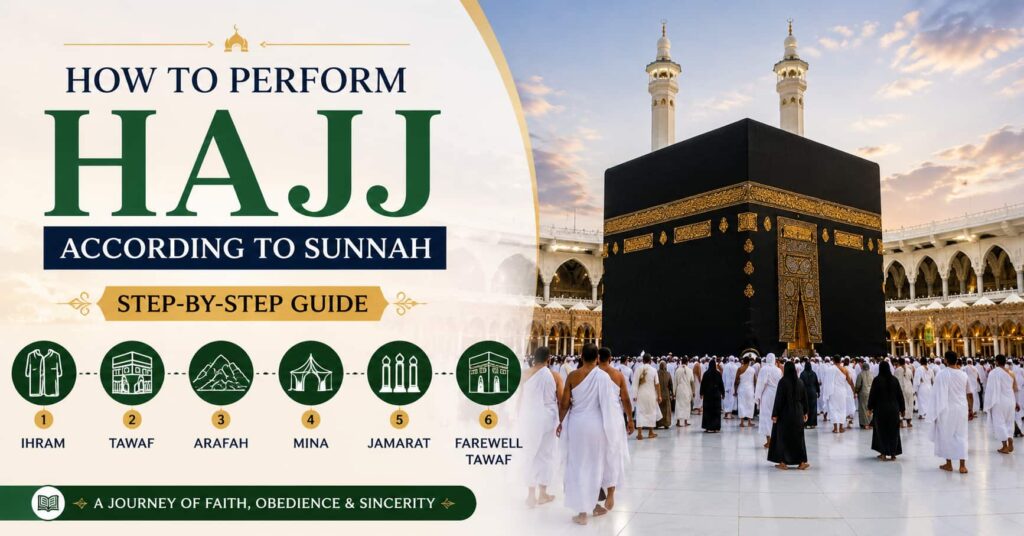
Every year, millions of Muslims from all around the world travel to Makkah with tears in their eyes and one sincere desire in their hearts: to perform Hajj for the sake of Allah. Rich and poor, black and white, Arab and non-Arab—people from every background stand together in the same simple white clothes. In that moment, everyone is reminded of one powerful truth: before Allah, wealth, status, and nationality mean nothing. What truly matters is Taqwa (piety and sincerity).
Hajj is not just a physical journey; it is a journey of the heart and soul. It teaches humility, patience, sacrifice, and complete submission to Allah. Hajj is also one of the five pillars of Islam and an obligation that every financially and physically capable Muslim must perform at least once in their lifetime.
What is Hajj in Islam?
Hajj, the fifth pillar of Islam, is the annual pilgrimage to Makkah performed during the Islamic month of Dhul Hijjah (the 12th month of the lunar calendar). It is a sacred act of worship that every financially and physically capable Muslim must perform at least once in their lifetime.
Allah says in the Qur’an:
“Pilgrimage to this House is an obligation by Allah upon whoever is able among the people. And whoever disbelieves, then surely Allah does not need (any of His) creation.”
(Surah Aal-Imran 3:97)
Hajj is not just a simple journey to Makkah. It is a journey of faith, forgiveness, sincerity, and complete obedience to Allah. During Hajj, Muslims leave behind worldly comforts and stand before Allah with humility, hoping for His mercy and forgiveness.
The Prophet Muhammad ﷺ said:
“Whoever performs Hajj and does not commit sin or wrongdoing will return like the day his mother gave birth to him.”
(Sahih al-Bukhari)
Types of Hajj
| Main Features | Hajj al-Tamattu’ | Hajj al-Qiran | Hajj al-Ifrad |
| Meaning / Method | Perform Umrah first, then Hajj separately | Perform Umrah and Hajj together without leaving Ihram | Perform only Hajj without Umrah |
| Ihram Status | Two Ihrams (one for Umrah, one for Hajj) | One continuous Ihram for both Umrah and Hajj | One Ihram only for Hajj |
| Umrah Included? | Yes, before Hajj | Yes, combined with Hajj | No Umrah included |
| Break Between Rituals | Yes, a break between Umrah and Hajj | No break, continuous worship | No Umrah stage at all |
| Sacrifice (Hady) | Required for most pilgrims | Required | Not required (in most cases) |
| Who Usually Performs It | Pilgrims coming from outside Makkah | Experienced pilgrims or those bringing sacrifice animal | People living in or near Makkah |
| Difficulty Level | Easiest and most common | Moderate, requires discipline | Simple but limited (Hajj only) |
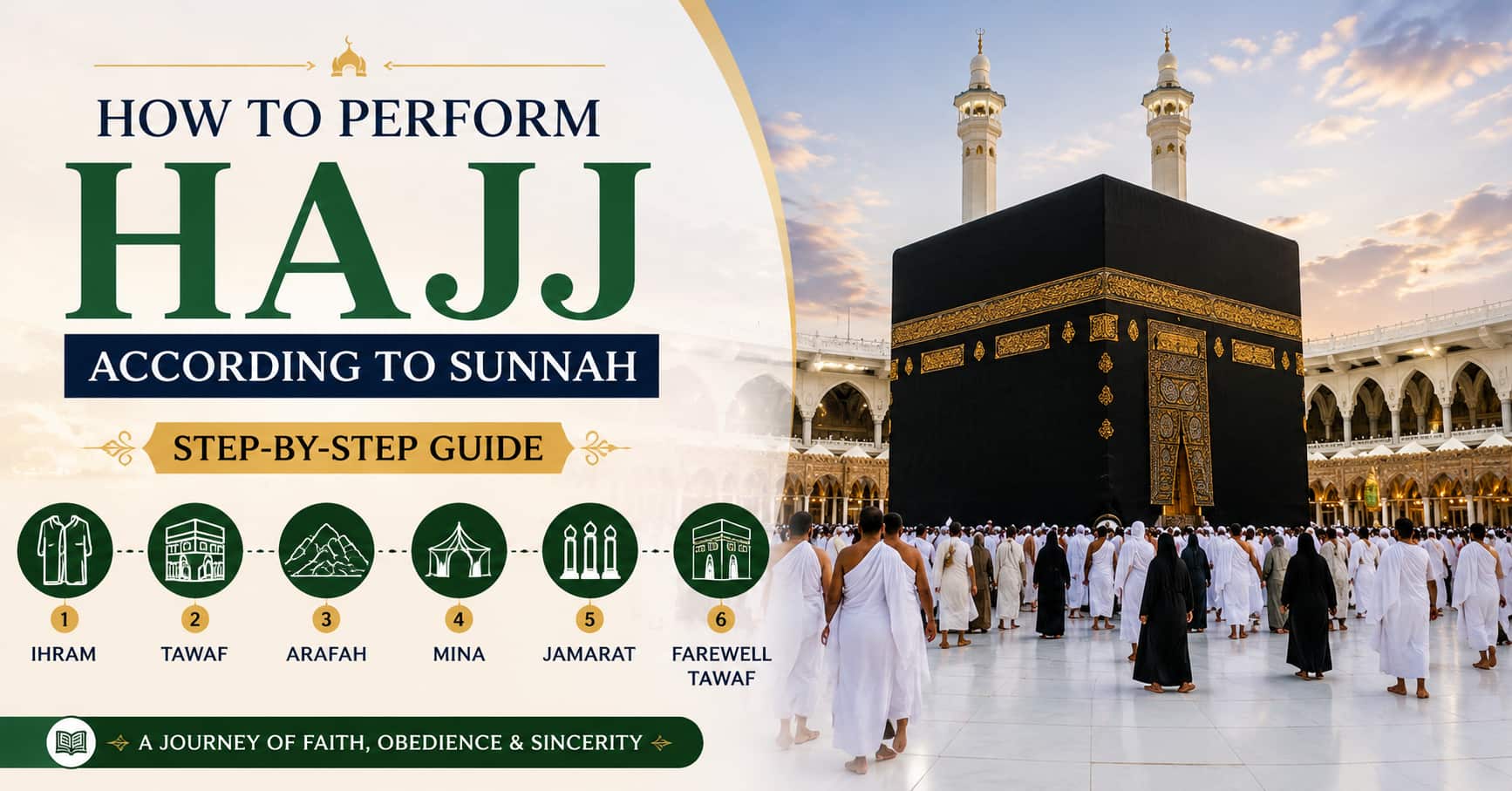
Performing Hajj According to Sunnah
Day 1 – Starting Your Hajj Journey
1. Entering Ihram
Ihram is a sacred state that Muslims enter before beginning Hajj or Umrah. It reminds every pilgrim of equality, simplicity, and humility before Allah, as everyone stands the same without any signs of wealth, status, or nationality.
Before entering Ihram:
- Take ghusl
- Apply perfume (men only before Ihram),
- Pray if possible.
What Men Wear During Hajj
- Two simple white unstitched cloths
- One cloth is wrapped around the lower body
- The other is placed over the upper body
What Women Wear During Hajj
- Modest Islamic clothing that covers the body properly
- No specific color is required
- Face and hands remain uncovered (according to most scholars)
2. Miqat – The Boundary for Ihram
Pilgrims must enter the state of Ihram before crossing the designated Miqat points, which are fixed boundary locations for starting Hajj or Umrah. After wearing the ihram, the pilgrim makes the intention (niyyah) for Hajj in their heart and then begins reciting the Talbiyah:
3. The Talbiyah
Muslims continuously recite the Talbiyah during Hajj and Umrah. This powerful declaration reflects complete submission to Allah.
Arabic
لَبَّيْكَ اللَّهُمَّ لَبَّيْكَ، لَبَّيْكَ لَا شَرِيكَ لَكَ لَبَّيْكَ، إِنَّ الْحَمْدَ وَالنِّعْمَةَ لَكَ وَالْمُلْكَ، لَا شَرِيكَ لَكَ
Meaning:
“Here I am, O Allah, here I am. You have no partner. Indeed, all praise, all blessings, and all sovereignty belong to You. You have no partner.”
Arriving in Makkah
4. Perform Tawaf
Pilgrims perform seven circles around the Kaaba in an anti-clockwise direction, known as Tawaf.
Important Sunnah Practices during Tawaf:
- Begin Tawaf from the Black Stone (Hajr-e-Aswad) if possible
- Start each round by saying “Allahu Akbar.”
- Keep the heart engaged in dua and remembrance of Allah throughout Tawaf
- Walk calmly with humility and focus, avoiding distractions
5. Pray Two Rak’ahs
After completing Tawaf, pilgrims perform two rak’ahs of prayer near Maqam Ibrahim. This prayer is a beautiful Sunnah that shows gratitude to Allah for allowing the completion of Tawaf.
6. Perform Sa’i ( Walking Between Safa and Marwah )
Pilgrims walk seven times between Safa and Marwah, a ritual known as Sa’i. It is performed after Tawaf during Hajj and Umrah. This act honors the great struggle of Hajra (AS), the wife of Prophet Ibrahim (AS), who ran between these two hills in search of water for her infant son Ismail (AS).
Day 8 of Dhul Hijjah
7. Mina
Pilgrims travel to Mina, a small valley near Makkah, where they stay as part of the Hajj journey. Mina is often called the “City of Tents” because millions of pilgrims gather there in simple tents, living in humility and devotion while focusing on worship and remembrance of Allah.
In Mina, pilgrims spend the day and night praying:
- Dhuhr
- Asr
- Maghrib
- Isha
- Fajr
During this stay, prayers are shortened (Qasr) but not combined, as each prayer is performed at its proper time.
Day 9 of Dhul Hijjah
8. The Day of Arafah (Arafat)
Pilgrims gather at Mount Arafat, spending the day in deep worship, making dua, seeking forgiveness, and remembering Allah with sincere hearts.
The Prophet Muhammad ﷺ said:
“Hajj is Arafah.”
(Sunan al-Tirmidhi)
This shows the importance of this day in Hajj. It is believed to be one of the most blessed days, when Allah forgives countless sins and grants freedom from the Hellfire to many of His servants.
9. After Sunset – Muzdalifah
After sunset on the day of Arafat, pilgrims travel to Muzdalifah, an open plain between Arafat and Mina. It is a simple and peaceful place where pilgrims spend the night under the open sky, reflecting and remembering Allah.
In Muzdalifah, pilgrims:
- Combine Maghrib and Isha prayers
- Sleep under the open sky in simplicity and humility
- Collect small pebbles that will later be used for the ritual of stoning the Jamarat
Day 10 of Dhul Hijjah – Eid al-Adha and Major Rituals
10. Stone Jamarat al-Aqabah
Pilgrims perform the ritual of stoning Jamarat al-Aqabah, the largest pillar located in Mina. In this act, they throw seven small pebbles at the pillar. This ritual symbolizes the rejection of Shaytan (Satan) and everything that leads a person away from the obedience of Allah.
11. Perform Qurbani (Sacrifice)
Pilgrims offer an animal sacrifice as part of the Hajj rituals, following the Sunnah of Prophet Ibrahim (AS). This act represents complete obedience to Allah and reminds us of Prophet Ibrahim’s (AS) willingness to sacrifice for the sake of Allah.
12. Shave or Trim Hair
After completing the main rituals of Hajj, pilgrims shave or trim their hair as a sign of humility and submission to Allah.
- Men usually shave their heads completely, although trimming is also allowed.
- Women trim a small portion of their hair, usually the length of a fingertip.
13. Tawaf al-Ifadah
Pilgrims return to Makkah to perform another Tawaf around the Kaaba, known as Tawaf al-Ifadah. This is one of the major pillars of Hajj, and it is essential for the completion of the pilgrimage.
Days 11–13 of Dhul Hijjah
14. Rejecting Evil Repeatedly
Pilgrims continue the ritual of stoning the Jamarat pillars over the next two to three days while staying in Mina. Each day, they throw seven pebbles at each of the three pillars—the small, medium, and large Jamarat. This repeated act symbolizes the ongoing struggle against Shaytan and the commitment to resist temptation in daily life.
15. Tawaf al-Wada (Farewll Tawaf)
Before leaving Makkah, pilgrims perform a final Tawaf around the Kaaba, known as Tawaf al-Wada.
This is often one of the most emotional moments of the entire Hajj journey. Many pilgrims feel deep sadness as they prepare to leave the sacred city and the House of Allah. Tears flow easily as they make heartfelt duas, asking Allah to accept their Hajj and grant them the chance to return again.
Conclusion
For those blessed with this opportunity, Hajj should be performed with sincerity, patience, and full attention to its purpose. Avoid distractions, stay focused on worship, and try to understand the meaning behind every action rather than just following the crowd. Most importantly, prepare your heart before you prepare your journey, because Hajj is accepted not by appearance, but by intention and devotion.
May Allah grant every Muslim the chance to visit His sacred house, accept their Hajj, and allow them to return as pure as the day they were born. Ameen.